


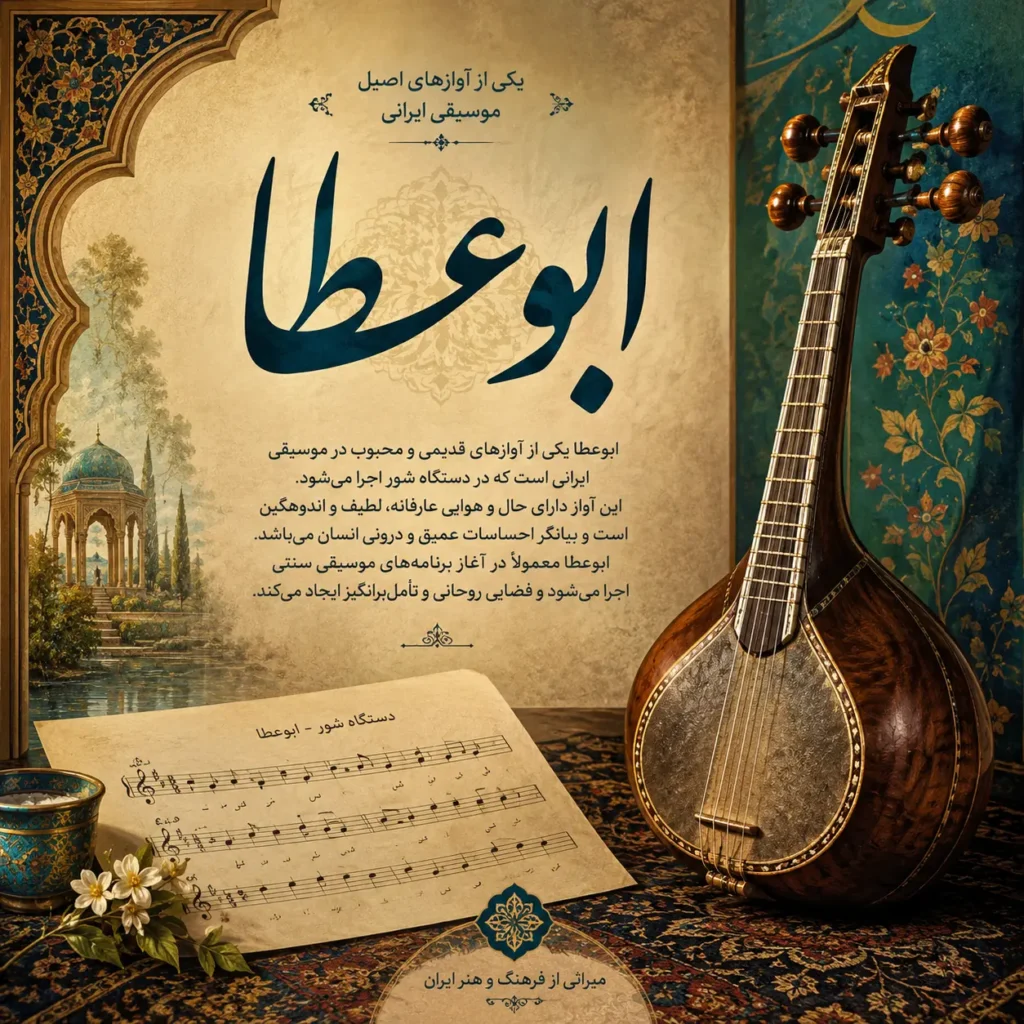
In the vast landscape of Persian classical music, the Radif system serves as the foundational framework for artistic expression. Within this system, Abu Ata stands out not merely as a melodic mode, but as a profound medium for introspection. Categorized as an Avaz—a derivative vocal form—closely linked to Dastgah-e Shur, Abu Ata is celebrated for its ability to transform musical sound into a vehicle for deep emotional inquiry and private contemplation.
The Modal Identity and Structure
Abu Ata’s unique identity lies in its subtle deviation from the parent mode, Shur. While it shares the same tonal foundation, it emphasizes specific intervals that shift the atmosphere from the broad, expansive nature of Shur to a more intimate and nuanced space. The structure of Abu Ata is built upon a sequence of Gusheh (melodic episodes), including:
Saykhi: Often serving as an early developmental phase that establishes the emotional tone.
Hejaz: Frequently considered the emotional climax of the mode, where the melody climbs into higher registers, allowing the performer to express profound longing.
Gabri: Providing a distinct rhythmic and modal contrast that adds depth to the performance.
Takht-e Taghdisi: A concluding segment that guides the listener back toward the final cadence with a sense of resolution.
The Aesthetics of Introspection
The true power of Abu Ata lies in its psychological impact on the listener. Unlike modes designed for celebration or grandeur, Abu Ata is the “voice of the inner self.” It is inherently suited for poetry that explores themes of yearning (Hojran), spiritual solitude, and the quiet pain of existence.
Musicians often use Abu Ata to create a musical dialogue that feels personal, as if the performer is whispering secrets to the audience. This quality of “introspection” is achieved through tahrir (vocal ornamentation) and pesh-daramad (rhythmic introductions) that demand patience and deep listening, inviting the audience to reflect on their own experiences while immersed in the melody.
Conclusion
Abu Ata remains one of the most vital components of the Persian musical heritage because it acknowledges the human need for reflection. It proves that music does not always need to be loud or elaborate to be powerful. By mastering the delicate balance between technical precision and emotional vulnerability, the artist turns Abu Ata into a mirror, reflecting the complexity of the human soul. Through this art form, Persian music transcends its role as entertainment, becoming an essential practice of mindfulness and emotional resonance.