


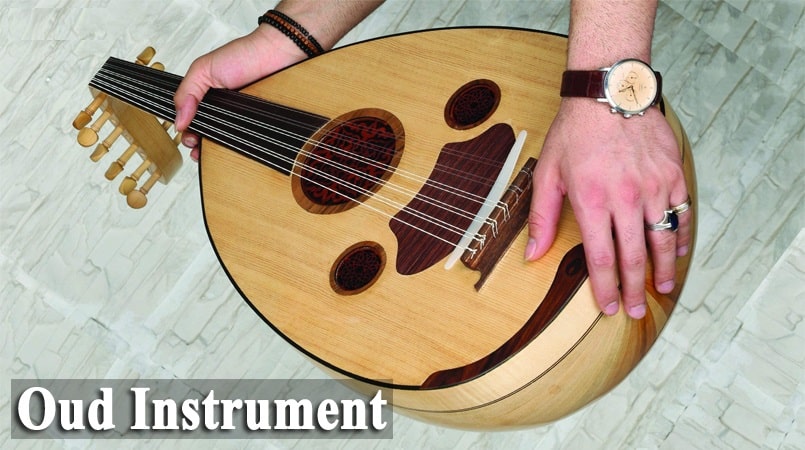
The Barbat (also spelled Barbat, Barbud, or historically Roud) is one of the oldest and most influential Iranian string instruments. It is the ancient Persian ancestor of the modern oud, an instrument that has become central to the musical traditions of the Middle East, North Africa, and parts of Central Asia. Throughout history, the Barbat has played a significant role in Persian classical music and has greatly influenced the development of many other stringed instruments around the world.
History and Origin
Archaeological discoveries indicate that instruments closely related to the Barbat existed in ancient Mesopotamia and the Iranian Plateau more than 5,000 years ago. Images of pear-shaped lutes have been found on Sumerian artifacts from the ancient city of Ur, as well as in Egyptian murals dating back over 2,000 years. These discoveries demonstrate that the Barbat belongs to one of the world’s oldest continuous families of musical instruments.
During the Sasanian Empire (224–651 CE), the Barbat reached its artistic peak in Persia. It was performed by legendary court musicians such as Barbad, Nakisa, Bamshad, and Ramtin, whose musical achievements became an enduring part of Persian cultural history. Their performances helped establish the Barbat as one of the most respected instruments of the royal courts. Following the spread of Islam, the instrument traveled throughout the Islamic world, extending from Persia to the Arabian Peninsula, North Africa, Central Asia, and eventually Al-Andalus (Islamic Spain). One of the most influential figures in this journey was the Persian musician Ziryab, who introduced and refined the instrument in Córdoba during the 9th century. His innovations profoundly influenced European musical culture and contributed to the evolution of the lute, which later inspired the development of the modern guitar.
Name and Etymology
The Persian name Barbat is believed to refer to the instrument’s distinctive shape, often compared to the breast of a duck. Another historical Persian name for the instrument is Roud, meaning “string” or “stringed instrument.” After its adoption by Arabic-speaking musicians, it became known as the Oud, a word meaning “wood,” referring to its wooden soundboard. When the instrument reached Europe during the Middle Ages, it became known as the Lute, one of the most important instruments of Renaissance and Baroque music.
Construction
The Barbat features a large pear-shaped wooden body, a short neck, and a rounded back made from multiple wooden ribs. Unlike many other lutes, it has no frets, allowing performers to produce the subtle microtonal intervals that characterize Persian and Middle Eastern music. Modern Barbats commonly have 11 strings arranged in five double courses and one single bass string, although different regional traditions may use 10, 11, or 12 strings. The instrument is played with a long plectrum (risha or mezrab), which produces its distinctive rich and expressive tone.
Sound and Performance
The Barbat produces a warm, deep, soft, and resonant sound with remarkable expressive capabilities. Its fretless fingerboard enables performers to execute delicate ornamentation, slides, and microtonal intervals that are essential to Persian classical music. The instrument is equally suitable for solo performances, ensemble music, and orchestral settings. Its rich tonal range allows it to perform lyrical melodies, rhythmic accompaniment, and complex improvisations with equal effectiveness.
Cultural Significance
Today, the Barbat has experienced a remarkable revival in Iran, where musicians and instrument makers have worked to restore its historical identity alongside the modern oud. It is regarded not only as a symbol of Persian musical heritage but also as one of the most influential instruments in world music history. Through centuries of cultural exchange, the Barbat gave rise to numerous members of the lute family and ultimately influenced the development of many Western string instruments, including the European lute and the modern classical guitar.