


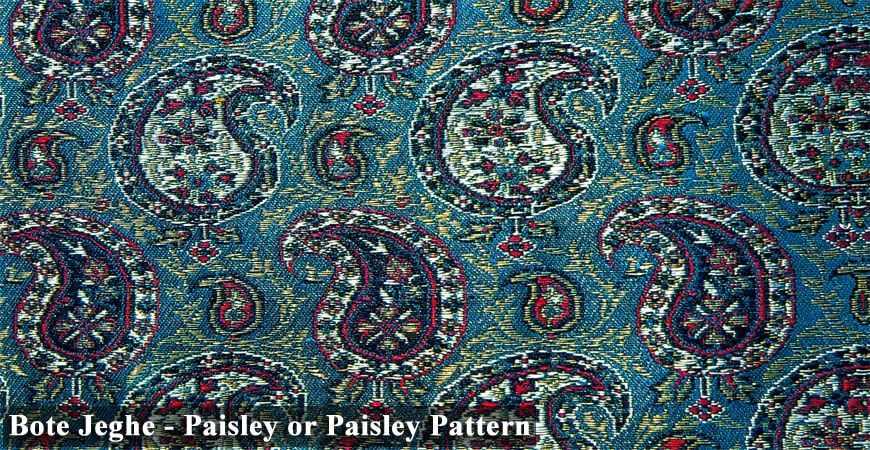
The Boteh Jegheh, internationally known as the Paisley motif, is one of the most recognizable and enduring decorative designs in the world. Characterized by its elegant teardrop-shaped form with a curved tip, the motif has appeared for centuries on Persian textiles, carpets, miniature paintings, ceramics, architecture, and traditional clothing. Although today it is associated with fashion and design across many cultures, the Boteh Jegheh originated in ancient Persia, where it became a powerful artistic symbol representing life, growth, spirituality, and eternity.
Over thousands of years, this iconic motif traveled along trade routes, inspired artists from Asia to Europe, and eventually became one of the world’s most influential ornamental patterns. Today, the Boteh Jegheh continues to appear in luxury fashion, interior design, home décor, jewelry, and graphic arts, connecting modern creativity with one of Persia’s greatest artistic legacies.
Origins of the Boteh Jegheh
The exact origin of the Boteh Jegheh remains a subject of scholarly discussion, but most historians agree that the motif emerged in ancient Persia several centuries before the Islamic period. Archaeological evidence and historical artworks suggest that early forms of the design appeared during the Achaemenid and Sasanian periods, later becoming a defining element of Persian decorative arts.
The Persian word “Boteh” refers to a shrub, bush, or cluster of leaves, while “Jegheh” originally described a decorative plume or ornament worn on royal crowns and ceremonial headwear. Over time, these concepts merged into the elegant curved design recognized today.
The motif became particularly popular in Safavid Persia (1501–1736), when Persian textile weaving, carpet production, and miniature painting reached extraordinary levels of artistic refinement. During this golden age, Boteh Jegheh patterns decorated luxurious silk fabrics, royal garments, carpets, manuscripts, and palace interiors.
Meaning and Symbolism
The beauty of the Boteh Jegheh lies not only in its graceful appearance but also in its rich symbolic meanings. Throughout Persian history, the motif has represented several interconnected concepts depending on the cultural and historical context.
One common interpretation sees the design as a stylized cypress tree bending before the wind. In Persian culture, the cypress symbolizes strength, resilience, freedom, and eternal life. The curved form represents humility without losing dignity or inner strength.
Another interpretation connects the motif to a flame or sacred fire, reflecting the influence of ancient Zoroastrian beliefs, where fire symbolized purity, wisdom, and divine light.
Some scholars believe the motif resembles a seed, leaf, flower bud, or embryo, representing fertility, rebirth, prosperity, and the continuous cycle of life. Others view it as a harmonious combination of natural forms rather than a direct depiction of any single object.
Because of these layered meanings, the Boteh Jegheh became a universal symbol of life, renewal, protection, and spiritual growth.
The Journey from Persia to the World
As Persian merchants traveled along the Silk Road and maritime trade routes, textiles decorated with Boteh Jegheh spread across Central Asia, the Indian subcontinent, the Ottoman Empire, and eventually Europe.
The motif gained enormous popularity in Kashmir, where local artisans adapted Persian designs into luxurious wool shawls. During the eighteenth and nineteenth centuries, these Kashmiri shawls became fashionable throughout Europe.
The Scottish town of Paisley became famous for producing machine-woven versions of these shawls during the Industrial Revolution. Because European consumers associated the pattern with products manufactured there, the design gradually became known internationally as the “Paisley pattern.”
Although the international name changed, the artistic roots of the motif remained firmly connected to Persian culture and craftsmanship.
Boteh Jegheh in Persian Art
The Boteh Jegheh occupies a central place in nearly every branch of Persian decorative arts. It appears in handwoven Persian carpets, silk textiles, embroidery, miniature paintings, tilework, wood carving, metalwork, jewelry, and manuscript illumination.
Persian carpet weavers often combine rows of Boteh motifs with floral gardens, arabesques, and geometric borders to create harmonious compositions. In traditional Persian textiles, the motif may appear individually or repeated in highly symmetrical arrangements.
Miniature painters frequently used the motif to decorate clothing, royal tents, architectural elements, and luxurious fabrics depicted within their paintings.
Each region of Iran gradually developed its own variations of the design, resulting in countless artistic interpretations while preserving the motif’s essential identity.
Modern Design and Global Influence
Today, the Paisley motif remains one of the world’s most recognizable decorative patterns. It appears in haute couture, luxury fashion houses, neckties, scarves, dresses, wallpapers, furniture fabrics, accessories, ceramics, and digital graphic design.
Many international designers continue to reinterpret the traditional Persian motif using contemporary colors, abstract compositions, and innovative materials while maintaining its instantly recognizable silhouette.
Despite its widespread global popularity, many historians and art scholars emphasize its Persian origin and its deep cultural significance within Iranian artistic heritage.
Variations of the Motif
Over centuries, artists have created numerous variations of the Boteh Jegheh. Some are slender and elongated, while others are broad and rounded. Certain designs are filled with delicate floral ornaments, birds, vines, or geometric decorations, whereas others remain simple and elegant.
Persian artisans often combined multiple Boteh motifs of different sizes within a single composition, creating dynamic visual movement and balance. These variations demonstrate both the flexibility of the design and the remarkable creativity of generations of Iranian artists.
The Legacy of the Boteh Jegheh
Few decorative motifs have enjoyed the global influence and longevity of the Boteh Jegheh. For more than a millennium, it has crossed cultures, religions, languages, and artistic traditions while preserving its essential beauty and symbolic richness.
From royal Persian courts to modern fashion runways, from handwoven carpets to digital illustrations, the Boteh Jegheh continues to inspire artists, designers, and collectors around the world.
Its enduring popularity reflects not only the elegance of its shape but also its ability to express universal ideas of life, beauty, resilience, creativity, and cultural continuity.
Cultural Significance
The Boteh Jegheh is far more than an ornamental pattern; it is one of the defining symbols of Persian artistic identity. It represents centuries of creativity, craftsmanship, and cultural exchange that have shaped Iranian art and influenced decorative traditions across the globe.
As one of Persia’s greatest artistic contributions to world culture, the Boteh Jegheh remains a timeless reminder that beautiful ideas can transcend borders, generations, and civilizations. Whether seen on an ancient Persian carpet or a modern fashion collection, this iconic motif continues to celebrate the enduring spirit of Persian art.