


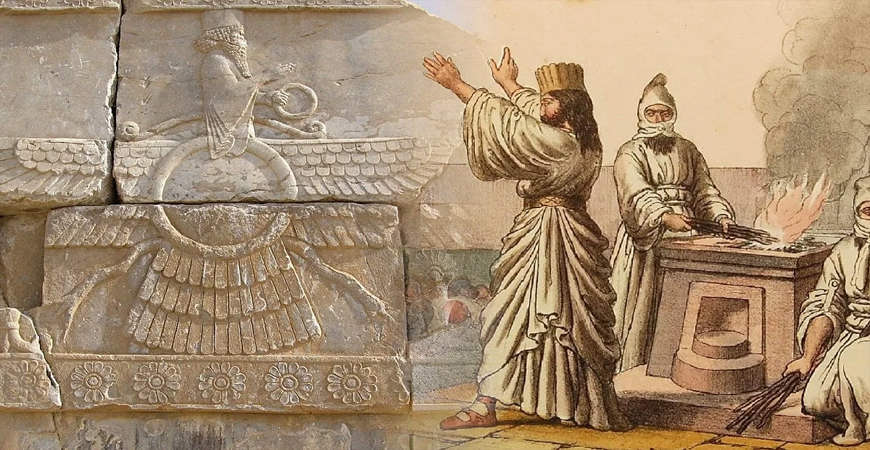
Zoroastrianism is one of the world’s oldest religious traditions and one of the most influential spiritual philosophies to emerge from ancient Persia. Founded more than three thousand years ago by the prophet Zarathustra, also known as Zoroaster, this ancient faith introduced profound ideas about morality, human responsibility, the struggle between good and evil, and the pursuit of truth. Its teachings shaped Persian civilization for centuries and influenced many later religious and philosophical traditions.
The origins of Zoroastrianism are connected to Zarathustra, a visionary spiritual teacher who is believed to have lived in ancient Iran sometime between the second and first millennium BC. Although many details of his life remain uncertain, his message became one of the most important foundations of Persian spiritual and cultural identity. His teachings were preserved in the Avesta, the sacred collection of Zoroastrian texts, which contains hymns, prayers, and religious principles attributed to Zarathustra and his followers.
At the heart of Zoroastrianism is the belief in Ahura Mazda, the wise and supreme creator who represents truth, wisdom, order, and goodness. Zoroastrians believe that the universe is a place where the forces of truth and righteousness are constantly opposed by forces of falsehood and destruction. Human beings are given the ability to choose their path through free will, and they are responsible for their thoughts, words, and actions.
One of the most famous principles of Zoroastrianism is expressed through the concept of “Good Thoughts, Good Words, Good Deeds.” This simple yet powerful teaching emphasizes that a meaningful life is achieved through positive thinking, honest communication, and ethical behavior. It highlights the importance of personal responsibility and encourages individuals to contribute to the improvement of the world around them.
Fire holds a special symbolic importance in Zoroastrian tradition. It represents purity, divine light, wisdom, and the presence of truth. Zoroastrians do not worship fire itself; rather, fire serves as a sacred symbol of Ahura Mazda’s light and the spiritual clarity that guides humanity. Fire temples, where sacred flames are carefully maintained, have been important centers of worship and community throughout Zoroastrian history.
During the Achaemenid Empire, Zoroastrian ideas became deeply connected with Persian royal culture and governance. Several Achaemenid kings, including Cyrus the Great and Darius the Great, promoted principles of justice, order, and respect for different peoples, ideas that reflected many aspects of Zoroastrian thought. The concept of maintaining harmony between humanity, nature, and the divine played an important role in Persian leadership and society.
The Sasanian Empire later established Zoroastrianism as the official religion of Persia and supported the development of religious institutions, scholarship, and the preservation of sacred texts. During this period, Zoroastrian philosophy, rituals, and traditions reached a high level of organization and became a central part of Persian cultural life.
Zoroastrianism also contributed important ideas to world history, including concepts of moral choice, the final judgment, the battle between good and evil, and the ultimate triumph of righteousness. Many scholars believe that certain religious concepts that appeared in later traditions may have been influenced by interactions with Zoroastrian thought, although the extent of this influence remains a subject of academic discussion.
Despite facing challenges throughout history, including political changes and the decline of ancient Persian empires, Zoroastrianism has survived for thousands of years. Today, Zoroastrian communities continue to preserve their traditions, values, ceremonies, and teachings in different parts of the world, especially in Iran and India.
Zoroastrianism is more than an ancient religion; it is a philosophy centered on wisdom, responsibility, and the pursuit of truth. Its message of choosing goodness, protecting creation, and living with honesty remains meaningful even in the modern world. As one of the greatest spiritual legacies of ancient Persia, Zoroastrianism continues to represent the timeless ideals of light, knowledge, and human dignity.